A man sits at a desk at night with three monitors in front of him. His daughter stands in the doorway behind his shoulder, about a metre away, holding a drawing she made. He is facing the wall.
That is the whole film. It runs forty-nine seconds, it has no dialogue, and it is the first episode of a series we are calling Rooms: one room, two lights, one relationship, one night.
The constraint is the idea
The room has exactly two light sources. Cold cyan from the monitors, warm amber from the open door. They sit on opposite sides of the frame with a band of black between them, and the man stays in the cold one for the entire film.
He is not a villain and the film never suggests he is. He turns when she touches his shoulder. He smiles at her — a real smile, the best two seconds in the piece. He takes her drawing and tapes it to the bezel of his monitor, next to about thirty older ones that have been curling there for years. He never once says no to her.
That is the tragedy, and it is why the two lights matter more than any line of dialogue could. He loves her and he is pointed the wrong way, and the room says so before anything else does.
He crosses into the warm light exactly once, in the last shot. He crosses it by switching his own monitors off.
One still image, then camera moves
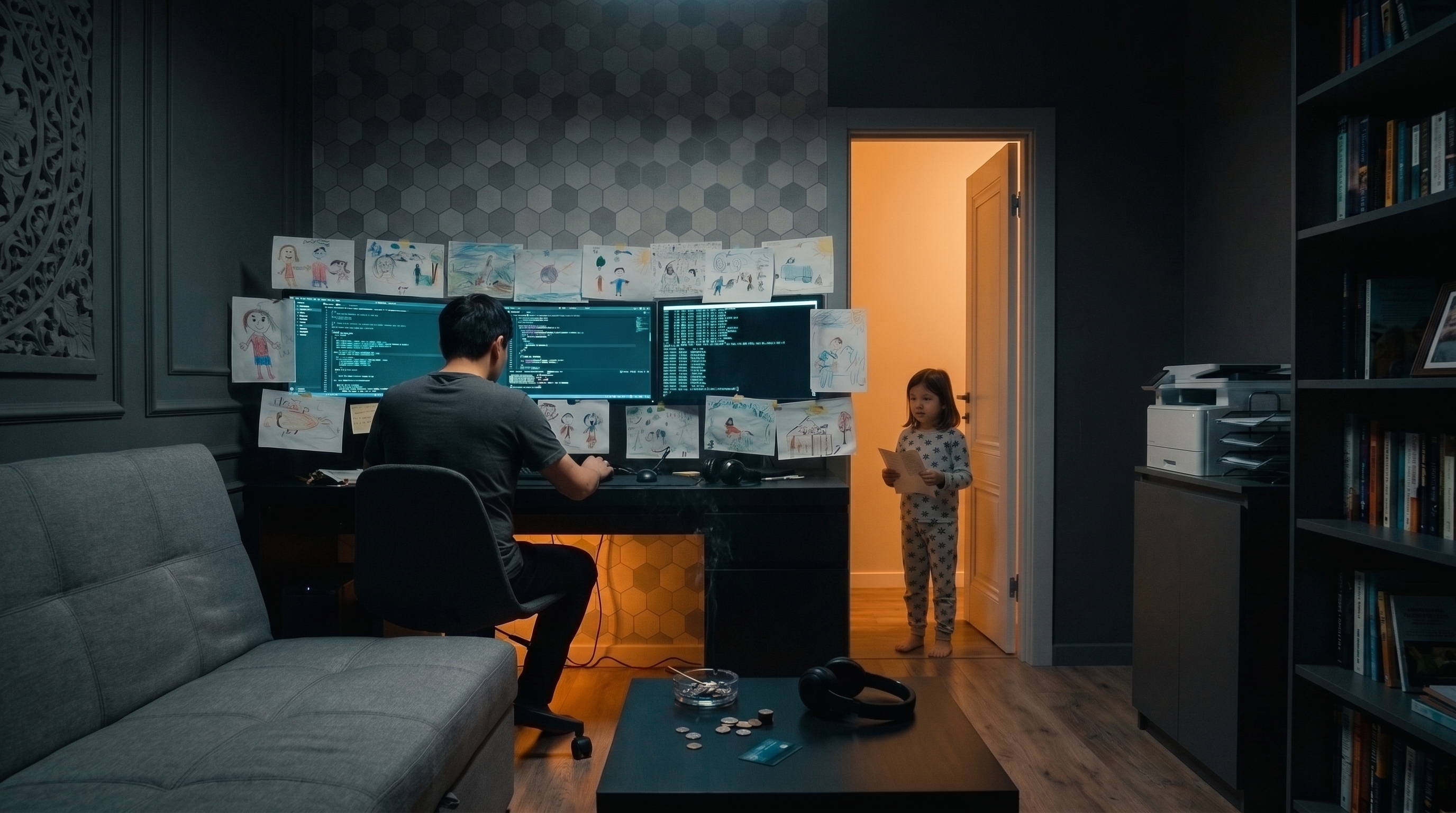
Everything you see came out of a single approved still of that room.
We had assumed we would need a separate generated image for every camera angle — one for the reverse, one for his face, one for the sofa. We tried it, and it failed in an instructive way: asked to describe the room from a new position, the model invented a second door on the wall it could see, because the door it had been told about was behind the new camera.
So we tested the cheaper thing instead. One still, loaded as the first frame, and a prompt that moved the camera. A slow push-in held every prop. A full pan right held the furniture, the wallpaper, the drawings, the bookshelf, the printer — no invented geometry anywhere.
That result deleted an entire line item. For a fixed-set narrative piece, camera movement is better coverage than new stills: cheaper, and more consistent, because the model is interpolating a space it already has rather than re-imagining one from a paragraph.
What it does not hold is performance. Write a prompt that is mostly camera and the model will fill the time itself — ours stood the man up and walked him out of frame while we were busy describing a pan. A camera instruction is not a performance instruction. Every person on screen needs their own action, stated for the full duration of the shot.
The ending exists because we were refused
We wrote an ending where he lifts his sleeping daughter off the sofa and carries her out of the room.
The safety model refused it, and refused an earlier beat where he kisses her hand. Both refusals are the same rule: an adult physically handling a child, which a classifier will block regardless of how domestic the rest of the scene is.
So we rewrote it. He stops typing. He stands, crosses the dark room, lays a blanket over her, and then reaches back and switches the monitors off one by one — until the cyan is gone and the only light left in the room is hers. Then he sits down on the floor beside her, in it.
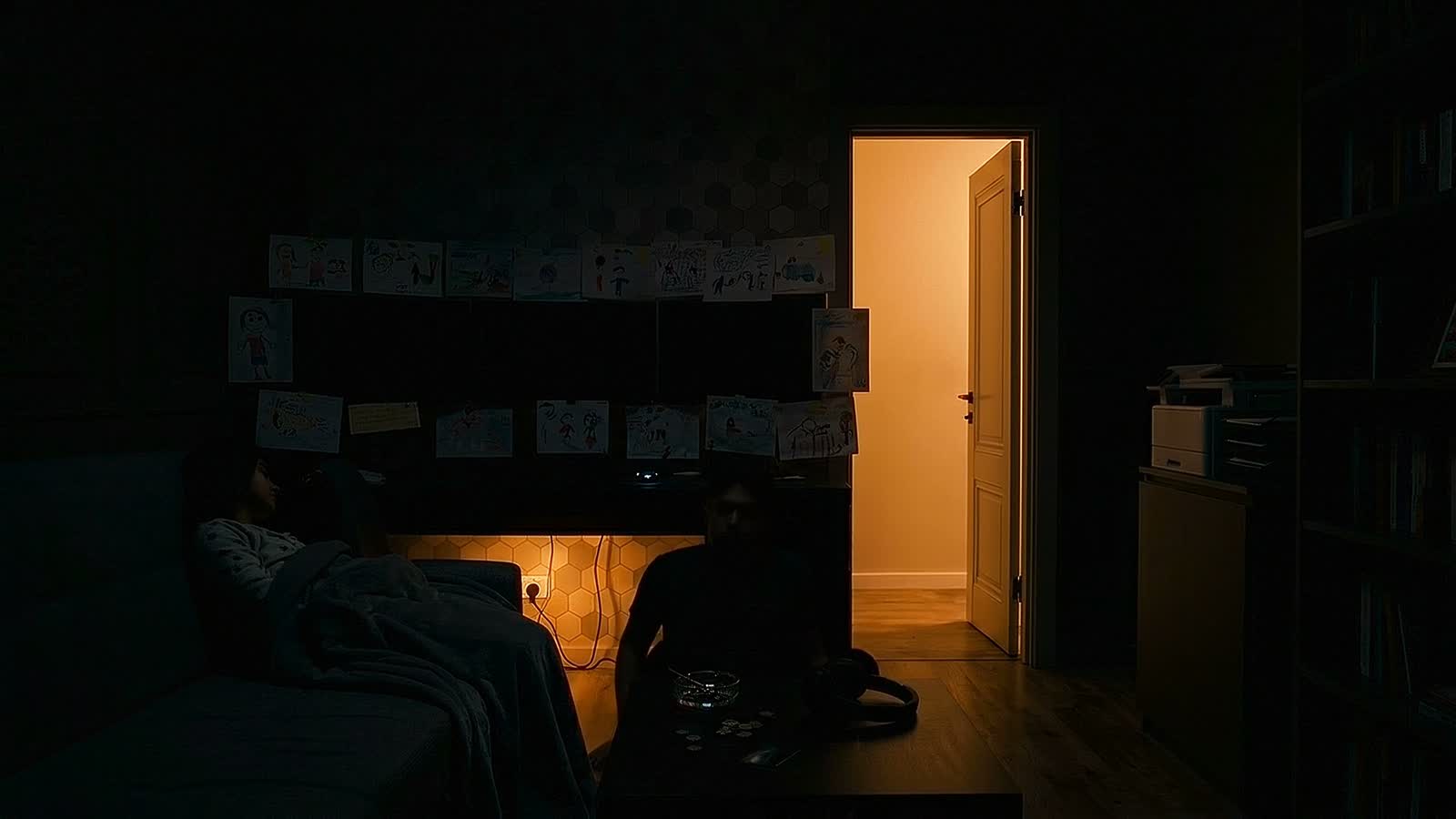
It is a better ending than the one we wrote. The film had spent its whole running time on two colours of light, and the version we were forced into resolves it in that language instead of with a hug. We would keep it now even if the original were allowed.
What is ours in it
The footage is generative — Google Flow, Veo 3.1 — and we say so on every platform it appears on.
What is not generative is the part that took the time. The room took ten image generations and four corrections before its geometry matched the one in our heads; the trail of that is still in our archive as three rejected sets. The shot list, the blocking, the decision to cut a twelve-scene script down to six, the sound bed, the edit, the grade, and the ending above — those are decisions, and decisions are the work. The model rendered them. It did not make them.
Episode 02
Same format. One room, two lights, one relationship, one night.
We have not chosen the room yet. If there is one you want to see — a kitchen at 3am, a car in a car park, a hospital corridor — tell us, because that is genuinely how we will pick it.